

Denver's Best Patio Company, Pergola & Custom Deck Builders
Best Quality Services from Denver Decks Available
Custom Deck Buiders
Denver Deck builders are more than just a one-trick pony. These custom construction professionals will work with you to create an incredible outdoor space that is tailored specifically for your needs and desires! This includes spiral staircase and custom rails.
Deck Services →Beautiful Outdoor Kitchens
Do you want a great place to cook outside? Denver Decks would love to design a custom outdoor kitchen for you today. We have great weather in Denver and we love to enjoy eating outside on the deck while being protected as well from the elements under a Patio Cover.
Outdoor Kitchens →Patio Covers & Deck Roofs
Need help with your patio cover design and construction? You're in luck! We have the perfect solution for you. With our very wide selection of materials and colors, we are confident that there is something to fit any need or preference. All types of roof styles.
Patio Covers →Concrete Patios
Concrete patios are a great way to extend your home outdoors. They come in all shapes, sizes and colors so you're sure to find one that will match your style and the color you're looking for! We have regular gray concrete but we also do stamped and colored concrete as well!
Concrete Pads & Patios →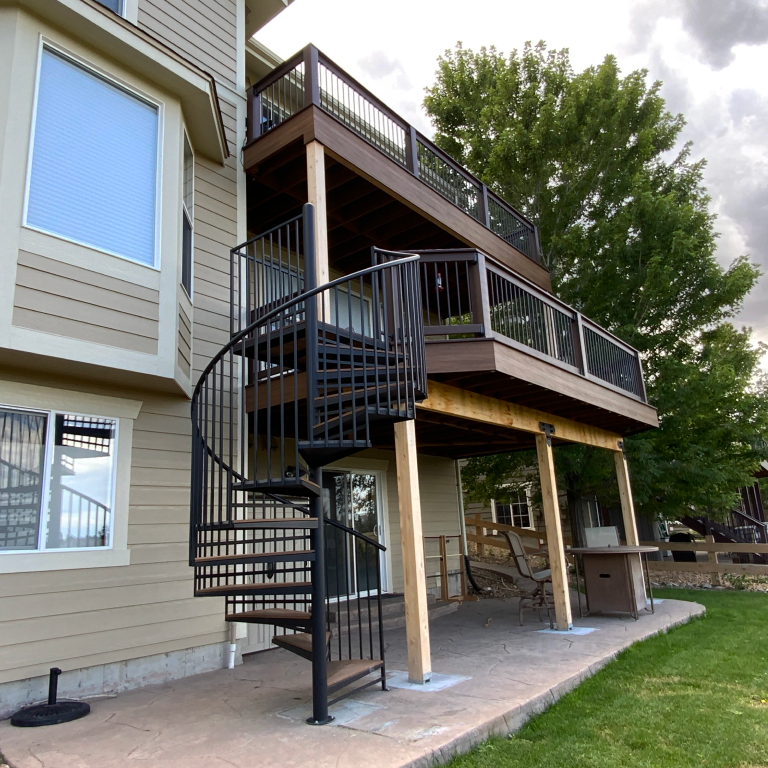
Your Trusted Deck Company, Pergola, and Concrete Patio Contractor near Denver
Many of the new and untested composite materials, solid plastics materials, vinyl coverings and even some fiberglass products have recently flooded the Denver decking market here and have some very lofty promises to limit, prolong or even to eliminate the normal maintenance problems of a deck. After extensive tested and by working with these new technologies over the years, these claim have not always been substantiated in reality. It has been our experience through use and rigorous testing, that a cap-stock decking material or mixed composite material are the ones we are recommending on a regular basis. These can actually provide the longevity, durability and can also limit the amount of normal maintenance, while staying in a reasonable cost range. Some more expensive PVC coated materials and also core composites can offer stain, fade and mold resistance that can make your life easier and subsequently, your deck will look and stay more beautiful with multiple color options for longer lasting, cooler and more durable deck surface aesthetics!
Denver Decks Portfolio
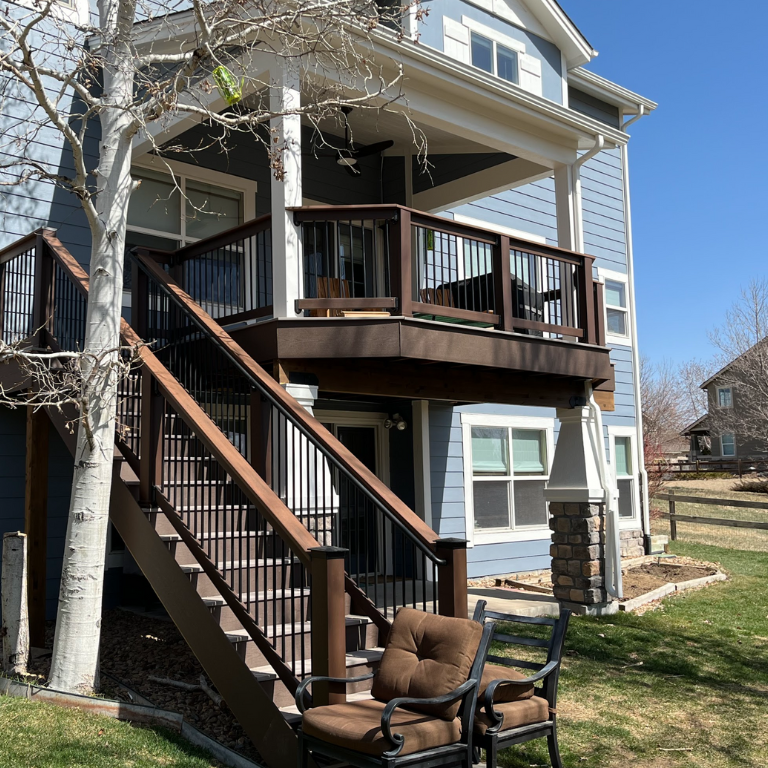
Philip, is the owner of Denver Decks and the managing member of Denver Decks, LLC - He is your Deck Answer Man, so please give him a call at 303-730-9642 for the accurate answers to a deck or patio questions.
He has a real passion to serve our Lord Jesus and your family well; and also to facilitate this same opportunity for these other men to serve your family too.
.jpg)

.jpg)
.jpg)
.jpg)
No Money Down, built on Trust.
Get a Quote from Denver Decks
We are happy to discuss the details of your project. We will typically get back to you within 24 hours. Please fill out all the fields below so that we can serve you best!
View our Google Profile

Denver Decks Product & Services
Over the past forty years we have been focusing our sights on the stronger, longer lasting and more durable deck products and their application systems. Although, we still construct a full line of products made with real woods; such as Heart Redwood, Western Red Cedar and all other types of Hardwoods coming from many places, generally outside of the United States. Although all of our structural framing materials are built with treated lumber, we will not use this type of treated product for the surface decking, fascia or railing components because of the possibility of severe splintering that is caused by our dry climate here in Denver, and because of some failures that we have seen in the field on some job sites that became unsafe (warping, cupping and grains being raised above the surface), knowing that this act of nature can be potentially harmfulness to humans and pets.
Our clients, are finding themselves with less free time on the weekends and way too many obligations with the time they do have to be spending their discretionary time sealing and staining the outdoor living space; they increasingly request products that require much less time and work of maintenance, with a greater durability.
The highest quality Materials
TimberTech, EverGrain, Trex, Fortress and Fiberon materials, are at the top of the list.
Allow us to share the positive and negative aspects from our perspective, of the most popular choices in today's decking, fascia and railing components on the market.
We only use quality materials for your outdoor project
These companies offer multiple levels of materials in a wide variety of colors and textures. They will differ in their quality, shape, color, density and longevity; and although each product has it's own limitations; each one of these products does have an optimal application. Allow one of our representatives to help you determine which product type and color blend that will work best for your deck or patio project. Having the first hand knowledge and experience with the benefits and draw backs of each of these systems, we can give you advise on a Company and their product type that will best encompass all that your family requires and that will promote the aesthetics that you are looking for in the overall scheme of things - for the total deck project.
Cedar Decks & Pergolas
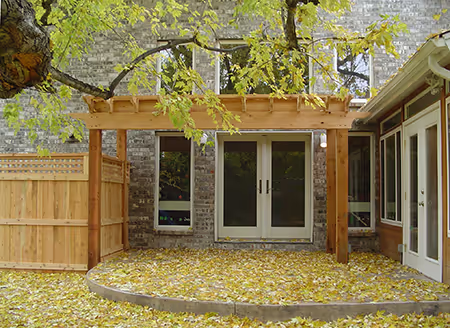
Cedar - has been widely used in the United States in various applications for hundreds of years and is certainly growing in popularity in today's decking and structural landscaping markets. Cedar is milled for so many different applications and textures making it the most versatile wood used in America today. Rough cuts are produced for fencing, siding, facing and trim boards. Large Timbers of all sizes are cut for both structural and architectural uses such as roofs, shade arbors, pergolas and gazebo components. Smooth cuts of the Cedar tree are so beautiful because of their grain and their knot configuration and are milled for many surface decking and railing applications; as well as fascia and skirting.
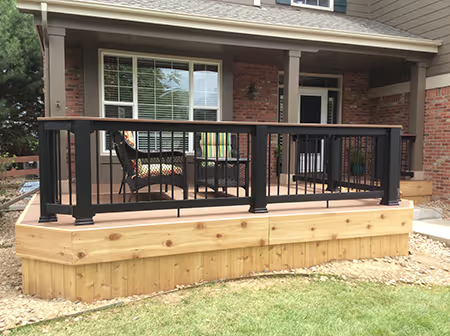
Cedar is very versatile and can be cut, routed and milled easily on the job site to fit any purpose. The strength of its grain allows it to be used in almost all structural uses, but generally it is used for surface aesthetics. Cedar is a soft wood, which allows it to age well in very dry climates like Arvada, Denver and Parker, Colorado, it also paints well and resists the normal cracking of denser woods, and dries very quickly in wet climates as well. Some types of Cedar wood have a very pleasing natural aroma and has a natural resistance to rot and decay. Cedar will oxidize and gray if it is not treated properly and will mildew or even get burned by the sun if it is over sealed with the wrong products. In Colorado's dry climate, Cedar needs to be sealed yearly or bi-yearly to maintain its natural beauty or should be professionally caulked and primed before being painted.

Redwood for Custom Decks near Denver
Redwood - has been American's primary choice for most decking products in the past several decades, but because of building overuse, misuse, over harvesting and forest mismanagement, it is quickly losing its charm and popularity here in Colorado because of its rising cost and very high maintenance issues as well. It has natural lasting beauty in its grain and knot configuration, with mixed colors of red and white Construction Common, B-grades and mostly red shades of Heart grades are still available. The nature of the Heart of the Redwood tree, allows it to be very naturally resistant to decay and can be used for many applications in the most humid of environments. In more arid environments like ours, it will tend to dry out too quickly, crack, split and raise its grain when not protected properly. The changing laws and management of the Redwood forests in the United States has greatly increased the cost and also limited the availability of these products. Redwood should be sealed every year in the early fall. Redwood should not be used in painting applications, for it bleeds it's natural color because of immature growth and clear cutting issues.
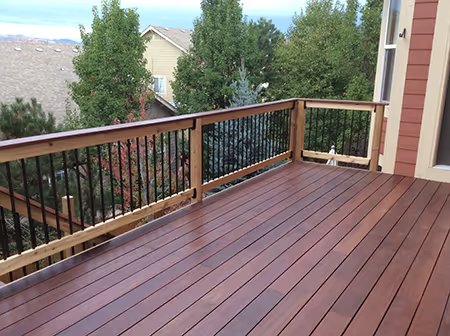
Upper Heart Redwood Deck w/ a wood Builder style snow railing

Hardwood for a high quality deck build
Hardwoods - like Belau, Mahogany, Ipe, Brazilian Redwood, Tiger Wood and Cypress have been widely used in the construction of decks and other landscape structures for many years in other countries, but have just recently been gaining in popularity in our area. The true beauty and consistency to a real hardwood product is very attractive to the consumer in these markets. The durability and longevity are clear acknowledgments of the hardness and extreme density of these hardwood trees. But, the sheer strength of a drying board of this density often requires a stainless steel screw (it can be quite costly to pre-drill every hole) application to hold it firmly in place and will also require high grade steel or titanium bits to bore pilot holes for each attachment.
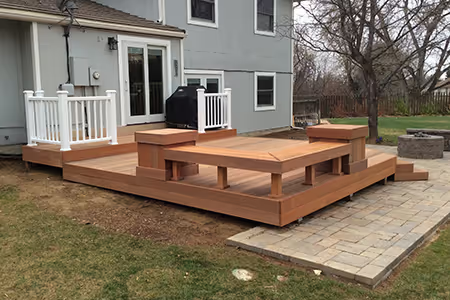
These Hardwoods require more intricate and involved construction applications, and in turn requires a more experienced, seasoned and talented carpenter. The additional labor involved with this type of construction can be as much as double the normal time and can cost between double and triple the normal labor fees depending on the finer details requested. In our climate, normal oil based sealants may take several additional days to soak into a hardwood product; many other circumstances of weather and temperatures can further delay this process; and certain species of wood may even require a Teak Wood Oil sealant. This should be applied by hand and the excess oil removed by hand as well.
Always building for sustainability and long term quality
The opinions expressed here are those of Denver Decks and more specifically of Philip R. Tussing, the owner of Denver Decks and your "Deck Answer Man". Note: The consumer should always thoroughly investigate a proposed product before choosing to purchase a deck material or any other product for use in their own construction project. It would also be prudent to test every opinion received and further entertained in order to determine its factual nature and practical application.
We have determined that products such as first and second generation composites, vinyls, hollow and solid plastics and fiberglass decking materials have too great of a financial or health risk, or may just have some type of liability that we are not willing to undertake without much more testing. We always like to see a product on the market and used here in Aurora, Denver and Parker, Colorado for some years, so we are able to see its benefits and draw backs (if any) before we start to integrate that system in our normal construction choices of deck construction. Deck products are always changing in an attempt to meet pressing needs and for future requirements, so we will endeavor to keep you informed of the newest and best developments that come our way in the deck industry.
GET IN TOUCH WITH THE DECK ANSWER MAN
The Best in Outdoor Design and Build
The Deck Answer Man program is now available to you and your family, that can provide access to the accurate answers to your specific deck and patio questions. All of these resources and this service has been provided at no cost to you, call our office at 303-730-9642 for the accurate help you need on your outdoor project
Denver, Westminster, and Arvada Deck Building, Pergola, Concrete Patio, & Outdoor Kitchen Services
View us on the map80202, 80203, 80204, 80205, 80206, 80207, 80209, 80210, 80211, 80218, 80004, 80007, 80002, 80005, 80003, 80021, 80033, 80030, 80403, 80031, 80030, 80234, 80021, 80221, 80003, 80260, 80020, 80023, 80005, 80241, 80602, 80229, 80233, 80260, 80023, 80216, 80601, 80221
Castle Rock, Parker, Highlands Ranch, Littleton, Centennial, Aurora & Lakewood Deck Building, Pergola, Concrete Patio, & Outdoor Kitchen Services
View us on the map80104, 80108, 80109, 80118, 80134, 80116,80138, 80134, 80107, 80116, 80112, 80117, 80102, 80126, 80129, 80120, 80130, 80128, 80127, 80125, 80123, 80433, 80124, 80122, 80112, 80121, 80015, 80111, 80016, 80010, 80011, 80013, 80017, 80018, 80019, 80045, 80012, 80014, 80016, 80228, 80226, 80215, 80232, 80227, 80214, 80235, 80465, 80123, 80401,
Denver, Arvada, Westminster & Thornton Neighborhoods We Provide Custom Decks Services
View us on the mapSandown, Holly Hills, Alamo Placita, Sullivan, Twin Lakes, Zuni, Sherrelwood, Western Hills, Montbello, College View, Leyden Junction / Wallace Village, Leyden, Mount Olivet, Semper, W 72nd Ave / Quaker St, W 64th Ave / Quaker St, W 64th Ave / Eldridge St, W 86th Pky / W 84th Pl, Shaw Heights, Berkley, W 104th Ave / Lowell Blvd, Federal Blvd / W 105th Dr, W 120th Ave / Frontage Rd, W 100th Ave / W 99th Ave, Federal Blvd / W 104th Ave, W 112Th Pl / W 113Th Pl, W 108th Ave / Oak St, W 108th Ave / Wadsworth Pky, Todd Creek, Eastlake, Quimby, North Washington / Welby, E 152nd Ave / Colorado Blvd, E 136th Ave / York St, E 160th Ave / Colorado Blvd, Henderson Rd / Riverdale Rd, E 128th Ave / Summit Grove Pky
Castle Rock, Parker, Highlands Ranch, Littleton, Centennial, Aurora & Lakewood Neighborhoods We Provide Custom Decks
View us on the mapOrsa, Happy Canyon / Silver Heights, Monte Vista Estates, Castle Pines Village, N Crowfoot Valley Rd / Knobcone Dr, Upper Lake Gulch Rd / Garton Rd, Route 83 / Route 86, Lone Tree, Stonegate, The Pinery, Franktown, Inverness, W Parker Rd / N Newland Gulch Rd, Tallman Dr / Club Dr, Cherry Hills Village, CO (City Center), Cherry Hills Village, CO (E Quincy Ave / S Downing St), Denver, CO (S Downing St / E Kentucky Ave), Denver, CO (S University Blvd / E Exposition Ave), Greenwood Village, CO (City Center), Greenwood Village, CO (E Belleview Ave / S Quebec St), Greenwood Village, CO (E Belleview Ave / S Yosemite St), Greenwood Village, CO (E Powers Dr / E Berry Ave), Littleton, CO (Fenders / Phillipsburg), Littleton, CO (N Highlands Ranch Pky / Fairview Pky), Fenders / Phillipsburg, Sedalia, Dome Rock / Longview, Ken Caryl, Highlands Ranch, Columbine, Roxborough Park, Gateway, Blakeland / Acequia, Wolhurst, Southglenn, Castlewood, Inverness / Dove Valley, E Arapahoe Rd / S Chapparal Cir W, E Orchard Rd / S Quebec St, E Dry Creek Rd / S Holly St, E Dry Creek Rd / S Quebec St, E Progress Dr / E Crestline Ave, E County Line Rd / E Phillips Ave, Watkins, Sable, Altura, E Smoky Hill Rd / S Tallyns Reach Pky, E Orchard Rd / S Waco St, E Ida Dr / E Low Dr, E Smoky Hill Rd / E Ridge Trail Dr, E Quincy Ave, E Smoky Hill Rd / S Gun Club Rd, E Quincy Ave / S Ensanada Way, Edgemont, Green Mountain Village, Spivak, W Alameda Pky / S Rooney Rd, W 32nd Ave / Kipling St, S Bristol St / W Exposition Dr, W 26th Ave / Simms St, W Jewell Ave / S Kipling Pky, W Bowles Ave / S Wadsworth Blvd, W Jewell Ave / S Bear Creek Blvd